Prospects Going Silent? Use An Evaluation Plan
Tell me if this is a familiar story… You are working with a prospect who is seemingly engaged and checking all the typical boxes in your sales funnel. One day, you call and leave a message…then an email… The next thing you know, three weeks has gone by and you’ve still not heard back. Sound familiar?
This is a common occurrence in sales and most sales leaders will suggest to move on from prospects who’ve disengaged. But should we be chalking it up a bad lead? If we altered our process, could we reduce the number of prospects who ghost us? The answer is YES!
Use an Evaluation Plan!
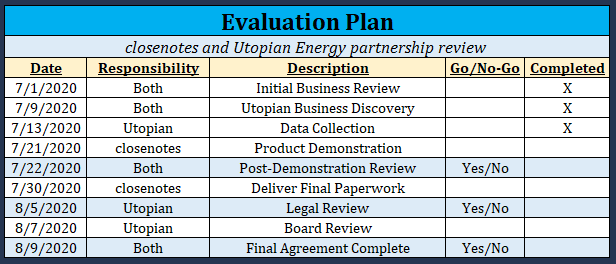
An evaluation plan goes by a few different names in the sales industry. It might also be called an Engagement Plan or a Review Plan, to name a few. At any rate, they operate in the same manner and there are a few elements that are absolutely necessary for them to work.
An evaluation plan is a timeline of agreed upon steps that integrate the buyer’s cycle and sales cycle together.
When to Introduce the Evaluation Plan
Evaluation Plans should be introduced as soon as you have a prospect or customer engaged in a thoughtful conversation. If they are interested in reviewing your products or services, it’s time to leverage the power of an Evaluation Plan!
Evaluation Plans are good for salespeople and for prospects. They give both parties control in the review process. Commonly, sales cycles and buyer cycles do not align. Evaluation Plans make it possible to map the two together and set appropriate expectations.
How to Introduce the Evaluation Plan
Remember, the Evaluation Plan is just as much for your prospect as it is for you. Here is a simple way to introduce the evaluation plan:
Salesperson: As we go through this review process with one another, I like to be sure I understand and am aligned with your needs. There are also certain steps that I need to complete so we meet your outcomes. Are you okay if I send over a draft document that combines both of our needs and relevant events?
Nine times out of ten, your prospect won’t have an issue! If they do, it’s likely you’re in a poorly qualified opportunity in the first place!
Key Elements of an Evaluation Plan
Dates - The first key element are time specific dates for each event or milestone. In the draft you send to your prospect, try to map out every major step all the way through contract signing—and maybe a few steps into implementation. Be realistic and give your prospect power to adjust those dates to fit their cycle. (Psst, you just improved your forecasting.)
Sales and Prospect Milestones - In your draft, include your key milestones, as well as what you typically see from your prospects. If your prospect has already given you key milestones—i.e., board review, multiple demonstrations, procurement—include them. (Psst, you just identified key barriers.)
Go / No-Go Milestones - There should be two or three key milestones that are Go / No-Go events. These are times where you or the prospect can be transparent and say things are not a good fit. This is reassuring to the prospect and will increase the likelihood that they are transparent, thus avoiding the infamous, “Gone Silent.” As you complete each of these milestones, confirm with your prospect that it’s okay to continue forward. (Psst, you just avoided No Decision and can understand why you’re losing.)
Moving from a Draft Evaluation Plan
Now that you’ve created your draft evaluation plan, it’s time to send to your prospect. Remember, this is as much the prospects as it is yours. You need them to add milestones, adjust dates, or remove milestones as needed. Ask your prospect to adjust as needed and confirm that it meets their expectations. Here’s an example:
Salesperson: Tim, please find the evaluation plan we discussed below. Please note, I am not sure of all key steps in your review process. I included dates for what we typically see, but please adjust those dates if you have certain needs. If you have certain steps you need to complete such as legal review or a board review, can you please add them as well?
Once your customer is engaged and you’ve both completed any adjustments. Confirm they agree on the stages and dates. This is powerful because it builds a sense of commitment.
Your prospects should automatically be more engaged in the process you’ve outlined, since they own it as much as you. While this isn’t a silver bullet to solving all ghosting problems but it will ultimately help you improve your sales process, forecasting, and conversion rate!
Download our Evaluation Plan and Email!
Take the first step to implementing an evaluation plan and start improving your sales conversion and velocity immediately! Join Black Bubble today for free and download our template!